


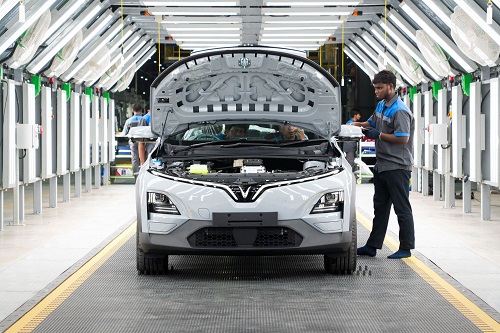
India’s electric-car market is still young, but VinFast is treating that as an opportunity to accelerate adoption, bringing an all-electric commitment that has shaped the Vietnamese automaker for more than four years.
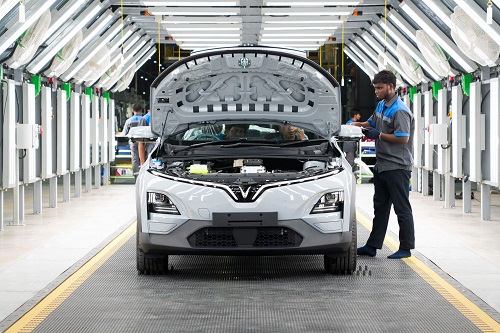 |
Since opening its Tamil Nadu manufacturing facility in 2025, VinFast has steadily expanded its presence across the country
Electric cars accounted for 8.5% of India’s passenger vehicle retail sales in September, according to industry data, as registrations nearly doubled from a year earlier. The figures point to a market gaining momentum, although EVs have yet to become mainstream. VinFast sees an opportunity to accelerate that transition rather than wait for it to happen on its own.
The company’s direction was set long before it entered India. In 2022, barely five years after its founding, VinFast decided to discontinue petrol-car production and become an all-electric manufacturer. It was a bold move for a young automaker that had only recently established its combustion-engine business, reflecting a conviction that electric mobility was the future worth pursuing.
That conviction extends well beyond manufacturing electric cars. Widespread EV adoption depends on vehicles that are attractive to buy, practical to operate and supported throughout their ownership life cycle. VinFast has therefore made charging, servicing and financial support integral to its business strategy, rather than treating them as services that can develop independently of vehicle sales.
A Conviction Put Into Practice
As it developed electric models alongside charging infrastructure and mobility services, VinFast has grown into Vietnam’s best-selling car brand. That experience helped shape a strategy in which the ecosystem surrounding the vehicle is developed alongside the vehicle itself.
India is now seeing that philosophy adapted to a much larger and more varied market, with early results suggesting growing momentum. Since opening its Tamil Nadu manufacturing facility in 2025, VinFast has steadily expanded its presence across the country. According to government data, the company registered 12,877 vehicles in the first nine months of 2026, with September alone accounting for roughly a quarter of that total. It ranked fourth among EV brands that month and had already achieved its year-end target of 75 dealerships, according to Tapan Ghosh, CEO of VinFast Asia.
Alongside its expanding sales and service network, VinFast has sought to tackle the economics of switching to electric motoring, offering free charging at eligible V-Green partner stations until March 2029, complimentary maintenance and residual value guarantees.
Viewed in isolation, these measures may look like conventional sales incentives. Taken together, however, they reveal the company’s wider calculation: making EV adoption mainstream requires making the entire proposition more appealing, from the initial purchase decision to years of ownership. That makes building an ecosystem a deliberate part of VinFast’s electric-only identity, rather than an accessory to it.
The stakes are substantial. India is the world’s third-largest car market, and VinFast wants it to become one of its biggest markets alongside Vietnam. But the importance of India goes beyond the number of vehicles the company could sell. It offers a setting in which VinFast can demonstrate how an EV-focused business operates across manufacturing, distribution and everyday mobility.
“If VinFast can crack the India market, it gives us confidence that we can replicate the Vietnam and India success stories in other markets,” Tapan Ghosh, VinFast’s Asia chief, told Nikkei Asia in an interview published on October 28.
His comments reflect an ambition that extends beyond individual markets. VinFast is seeking to develop an approach to electric mobility that can be adapted across countries with different consumer preferences, infrastructure needs and stages of EV adoption.
Beyond the Passenger Car
VinFast’s plans in India are already expanding beyond four wheels. The company signed letters of intent with more than 50 electric-motorcycle dealer partners in October and plans to introduce locally produced two-wheelers. Its strategic partner in electric ride-hailing service, Green SM, has also entered New Delhi, bringing its vehicles into the everyday transport market.
The common thread is a belief that electrification can extend across how people own, share and use transportation. Pursuing that transition has reshaped what VinFast manufactures, how it supports customers and where it intends to build its business. India is becoming an increasingly important expression of that strategy, and of the company’s determination to help create the market it hopes to serve.
About VinFast
VinFast (NASDAQ: VFS), a subsidiary of Vingroup JSC, one of Vietnam’s largest conglomerates, is a pure-play electric vehicle (“EV”) manufacturer with the mission of making EVs accessible to everyone. VinFast’s product lineup today includes a wide range of electric SUVs, e-scooters, and e-buses.
VinFast is currently embarking on its next growth phase through rapid expansion of its distribution and dealership network globally and increasing its manufacturing capacities with a focus on key markets across North America, Europe, the Middle East and Asia.
Learn more at: vinfastauto.in

