



On a morning in New Delhi, the Bharat Mobility Global Expo buzzed with the familiar hum of India’s automotive giants. Visitors wandered between displays of combustion engines and gleaming show cars, the kind of scene Delhi has hosted for decades. But in one corner of the hall, the crowd slowed. Two premium compact electric SUVs sat under the lights, the VF 6 and VF 7, their sharp V-shaped signatures glowing long before anyone registered the name on the stand.
 |
VinFast has quietly climbed into the ranks of India’s top electric vehicle brands
VinFast’s debut in India on Jan 17 of last year caught even veteran showgoers off guard. The company had brought right-hand drive versions tailored specifically for Indian consumers, a quiet signal that it was here with purpose, not testing the waters. Still, few in the hall recognized the badge. Amid the hum of announcements and clicking shutters, one visitor leaned toward a friend and asked, “Who are these people?”
That question did not hang in the air for long. In the weeks that followed, a group of Indian journalists traveled to Vietnam to see where the cars came from. What they discovered in the northen city of Hai Phong reframed everything.
“I had no idea VinFast is such a big group,” auto journalist Swati Agrawal recalled. “I saw the factory, the manufacturing plant, and not only cars, even scooters, buses, electric buses. Everything is being manufactured in one place. Three lakh cars per year. This is not a small brand.”
Her reaction points to a deeper story. VinFast’s sudden visibility in India is not merely an export push. It is the latest chapter in Vietnam’s own industrial transformation, one that has accelerated quickly enough to catch even Asia’s seasoned automotive observers off guard.
A 400-Acre Factory… From Nothing
By the time the expo lights dimmed, the next act of VinFast’s India story had already begun taking shape in Tamil Nadu months earlier.
To choose a location for its plant, the company surveyed fifteen sites across six states. Tamil Nadu, with its manufacturing-ready infrastructure and active support for green mobility initiatives, rose to the top. What happened next showed how the brand like to act. And it’s right there in the name: Fast.
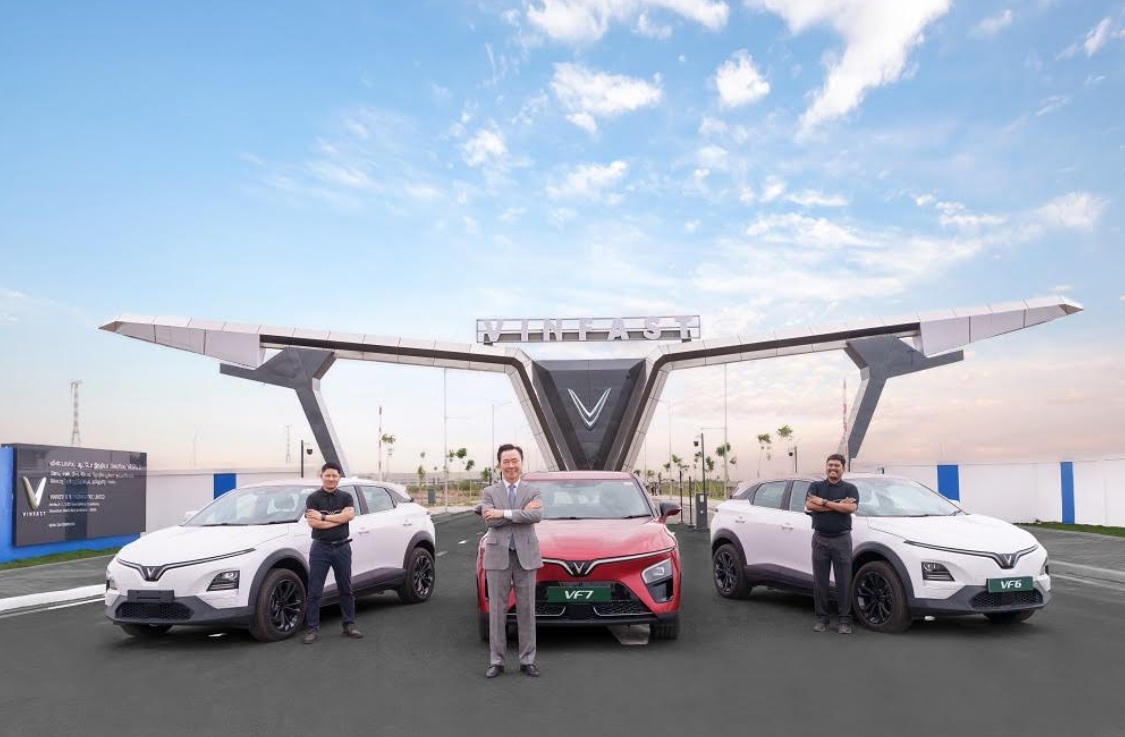
In late February 2024, when the groundbreaking ceremony began on a sun soaked, low lying tract of land near Thoothukudi, the site was still empty. By Aug 4, 2025, it housed India’s newest electric vehicle factory, a 400-acre complex with body shop, paint shop, general assembly, logistics warehouse, and supplier-ready zones.
“We entered India with nothing,” CEO Pham Sanh Chau said at the inauguration ceremony. “No land. No factory. No team. The only thing we had was a deep resolve and a belief that this area could become a leading hub for electric vehicles and auto components in South Asia.” He gestured to the plant behind him. “In just fifteen months, we transformed this land into a modern, highly-automated factory.”
When the first VF 6 and VF 7 rolled out that morning, they were the first VinFast vehicles to be made-in-India, by the hands and minds of Indian people, for Indian customers. “They are a symbol of the aspirations and resilience of the Indian people as they reach for a better, cleaner future,” Chau said.
The plant is expected to create 3,000-3,500 direct jobs and several thousand more across the supply chain as auxiliary partners move into the region. Suppliers have already expressed readiness to relocate workshops near the factory, a sign of confidence in Thoothukudi’s rise as an automotive production base.
In parallel, VinFast’s India team has moved quickly to build the retail and service backbone that can make or break an EV brand in this market. By end of 2025, the company had opened 35 dealerships, stretching from Delhi, Gurugram and Noida in the north to Mumbai, Pune, Chennai, Bengaluru, Kochi and Hyderabad.
Yet the most unusual part of the ecosystem lies in aftersales support. VinFast partnered with RoadGrid, myTVS and Global Assure with the aim of creating a full-fledged third-party service centers before the first customer deliveries. Global Assure will operate a round the clock helpline, roadside assistance and mobile service. RoadGrid and myTVS will handle charging, maintenance and diagnostics, including support in areas where VinFast does not yet have a showroom.
For a country where questions about EV service often outweigh questions about EV design, this infrastructure may prove decisive.
Financing, long a barrier for EV adoption in India, has also been addressed through agreements with major banks including HDFC Bank, Yes Bank, Axis Bank, and others. These arrangements offer everything from dealer inventory financing to 100 percent on-road customer loans, with bank officers stationed directly in showrooms for simplified approval.
“This is how you support an EV transition,” one banker at the Chennai showroom launch said. “You do not just sell cars. You build systems.”
And in the months since customer deliveries began, VinFast has quietly climbed into the ranks of India’s top electric vehicle brands. Industry registration data shows the company already placing among the country’s top 10 EV brands, a notable shift for a name that was unfamiliar to most Indians at the start of the year. Its early momentum, built on steady deliveries and expanding visibility on the roads, has reinforced what many analysts have begun to observe.
“I love one thing about Vingroup,” Swati says. “They know what they are doing. And if they have a plant in India, people will think you are not going to just sell the product and leave.” She adds, “In India, if you give good price, good range, and good service, the customers are yours.”
Why this first year matters
The rollout of Made-in-India VF 6 and VF 7 has already begun shifting industry perception. In April 2025, ABP Live named the VF 7 “Most Awaited New Car,” praising its design and advanced features. At the Jagran Hi-Tech Awards later in the year, VinFast was named “EV Manufacturer of the Year”, and the VF 7 won “EV Disruptor of the Year”.
“VinFast embodies the spirit of innovation and progress driving India’s EV transformation,” said Jagran’s auto editor Arjit Garg. He commented that the company has displayed a rare clarity of direction for a newcomer and a “people-first vision” that aligns with India’s long-term mobility goals.
VinFast’s long-term commitment became even more visible on Dec 4, 2025, when VinFast signed a new MOU with the Government of Tamil Nadu to expand its Thoothukudi facility by an additional 200 hectares. The second-phase investment will add production lines for electric buses, e-scooters and charging infrastructure, deepening localization and strengthening India’s emergence as a regional manufacturing hub. For many observers, the expansion underscored that the company’s commitment runs far beyond its initial launch.
With the factory inaugurated, dealerships opening, service networks activating and customers already booking, VinFast enters 2026 as a steady companion in India’s electric transition, intent on growing with the country.
Indian visitors to Vietnam say the brand’s trajectory feels familiar yet refreshing. Piyush, a journalist and content creator, thinks back to the sight of VinFast cars filling Vietnam’s streets. “I can imagine something similar happening in India,” he says. “Maybe after five or six years.”

