


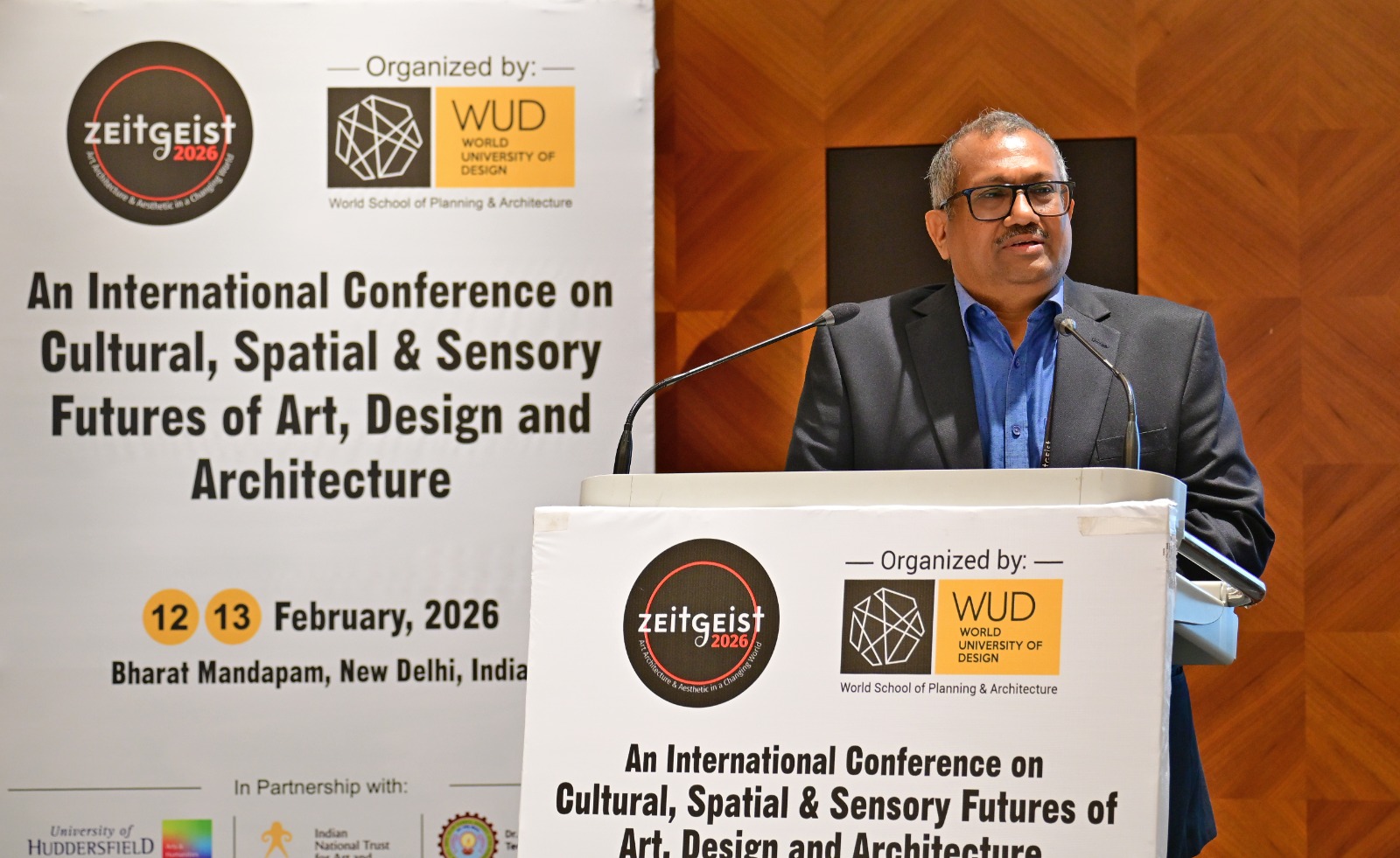
At a moment when artificial intelligence is reshaping creativity, climate change is redefining design briefs, and culture itself is being renegotiated, ZEITGEIST 2026 brought together some of the most compelling voices in art, architecture and design to ask a pressing question: What does it mean to design consciously in our time?
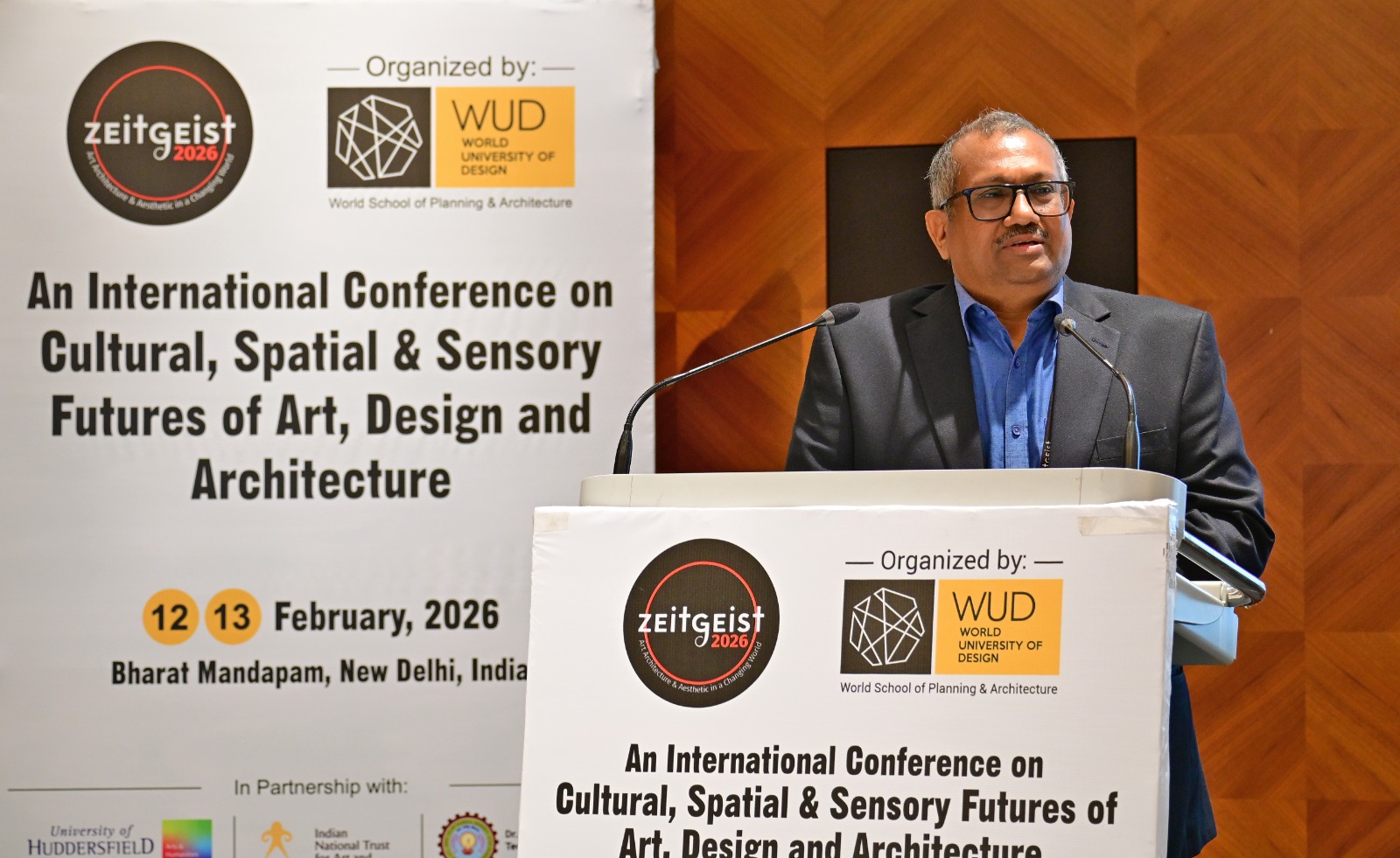 |
Dr. Sanjay Gupta, Chair of ZEITGEIST 2026 and Vice-Chancellor of the World University of Design
Held on 12th and 13th February at Bharat Mandapam, New Delhi, the international conference on Cultural, Spatial and Sensory Futures of Art, Design and Architecture was organised by the World University of Design. Over two days, scholars, practitioners, artists, and students engaged in conversations that moved well beyond aesthetics, into territory that was technological, political, ecological and deeply human.
The word Zeitgeist means the spirit of the times. But at this conference, it became more than a theme. It became a challenge. How do we design when authorship is shared with algorithms? How do we build when climate accountability is non-negotiable? How do we preserve heritage while imagining speculative futures?
The conference featured a powerful line-up of keynote speakers who set the intellectual tempo of the event. Dr. Sachchidanand Joshi, Member Secretary of the Indira Gandhi National Centre for the Arts, reflected on cultural continuity in a rapidly shifting world. Mr. Sanjoy Roy, Managing Director of Teamwork Arts, spoke on the role of creative ecosystems in shaping public imagination. Prof. Nic Clear of the University of Huddersfield explored speculative architecture and the impact of digital futures on design thinking. Dr. Ashok B. Lall, eminent architect and educationist, offered critical insight into sustainability and contextual practice. Artist Samar Jodha brought a transdisciplinary perspective that blurred boundaries between art, politics and lived experience.
“We are not simply designing objects anymore. We are designing systems, experiences, and cultural narratives,” said Dr. Sanjay Gupta, Chair of ZEITGEIST 2026 and Vice-Chancellor of the World University of Design. “This conference reflects a growing recognition that architecture and design are no longer peripheral to global change. They are central to it,” he added.
Across keynote lectures, research presentations, panels and workshops, participants debated themes ranging from immersive and hybrid environments to heritage-led innovation, sensory urbanism, regenerative design, and speculative futures. The dialogue was rigorous. It was sometimes provocative. It was deliberately interdisciplinary.
Dr. Shaleen Sharma, Co-Chair of ZEITGEIST 2026 and Dean of the School of Planning & Architecture at WUD, noted, “When technologists, conservationists, designers and cultural theorists from 45+ top institutions across the world sit at the same table, the conversation becomes richer and more responsible. That intellectual friction is necessary if we are to respond meaningfully to our times.”
“Architecture today operates in a field where physical space, digital environments, and speculative imagination intersect. The challenge is not simply to adopt new technologies, but to develop critical frameworks that allow us to design responsibly within them,” Prof Nic Clear from University of Huddersfield added.
The conference also highlighted the growing role of India within the global creative economy. With rapid growth in digital industries, immersive media, and design-led entrepreneurship, India’s cultural and spatial imagination is increasingly shaping global discourse. ZEITGEIST 2026 positioned these conversations within both international and local contexts.
More than a conventional academic gathering, ZEITGEIST functioned as a laboratory of ideas. It brought emerging researchers into dialogue with established practitioners. It connected technological experimentation with cultural memory. It asked participants not only to interpret the present but to influence the trajectory of what comes next.
As the sessions concluded, one idea resonated strongly across the forum: every era leaves evidence of its thinking in the spaces it builds. ZEITGEIST 2026 was not merely about describing the spirit of our times. It was about defining it.


