
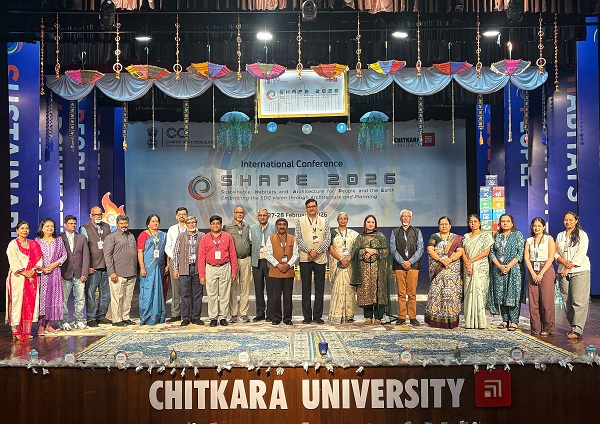
The Council of Architecture (COA) International Conference, SHAPE 2026: Sustainable Habitats and Architecture for the People and the Earth, successfully concluded at Chitkara University, Punjab, bringing together global leaders in architecture, urban planning, and sustainability for three days of academic exchange and policy dialogue on climate-responsive and people-centred built environments.
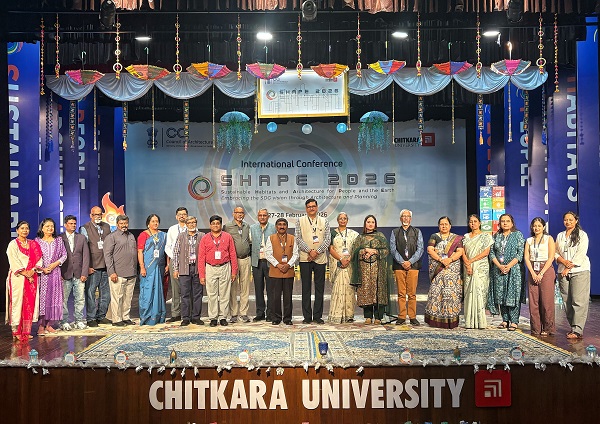 |
Members of the Council of Architecture with dignitaries at the International Conference SHAPE 2026 held at Chitkara University
Organised by the Council of Architecture, India, in collaboration with the Chitkara School of Planning and Architecture, Chitkara University, the international architecture conference was held from February 26 to February 28, 2026. The event convened leading architects, urbanists, policymakers, academicians, researchers, and students from across India and internationally, reinforcing India’s growing role in advancing sustainable architecture and urban futures.
SHAPE 2026 featured three keynote speakers and ten plenary speakers, along with specialised thematic sessions addressing critical global priorities, including climate-responsive architecture, sustainable urbanism, ecological design strategies, low-impact material innovation, community-centred development, and policy-driven architectural practice. Delegates and experts from South Africa, Norway, Switzerland, Germany, and the United States underscored the conference’s global significance and interdisciplinary scope.
Among the distinguished speakers, Prof. Ali A. Alraouf, Professor of Architecture and Urbanism at the University of California, Berkeley, USA, shared scholarly perspectives on contemporary urban transformation, contributing to deeper academic and professional discourse on sustainable habitats and resilient cities.
Delivering the Presidential Address, Dr. Abhay Purohit, President, Council of Architecture, emphasised the urgent need to integrate sustainability into architectural education and professional practice. He called for future architects and institutions to prioritise ecological responsibility, climate adaptation, and socially responsive design as central pillars of the profession.
The conference was also graced by Ar. Jayashree Deshpande, Director, COA–TRC, Pune, who highlighted the importance of research-driven architectural education in addressing complex environmental and societal challenges. As Convenor of SHAPE 2026, she outlined the conference’s academic vision and its alignment with the United Nations Sustainable Development Goals (SDGs). R. K. Oberoi, Registrar, Council of Architecture, was also present.
Highlighting the university’s commitment to sustainability and global academic engagement, Dr. Madhu Chitkara, Pro-Chancellor, Chitkara University, said, “At Chitkara University, we believe that sustainable habitats are not merely architectural outcomes but collective commitments to future generations. Hosting SHAPE 2026 reflects our commitment to advancing sustainable architectural education, fostering international academic collaboration, and enabling design innovation that serves both people and the planet.”
The conference hosted research paper presentations across five thematic tracks, with participation from 41 universities and academic institutions, strengthening interdisciplinary research and knowledge exchange in sustainable architecture and urban design. Best Paper Awards were presented in each thematic category, along with Certificates of Excellence recognising pre-conference academic contributions.
Held under the aegis of the Council of Architecture and hosted at Chitkara University’s Punjab campus, SHAPE 2026 concluded as a landmark international architecture conference in India, advancing dialogue on sustainable habitats, climate-responsive design, and the future of architectural education. The conference reaffirmed Chitkara University’s role as a global academic platform supporting research, innovation, and collaborative solutions for sustainable built environments.
About Chitkara University
Chitkara University is a UGC-recognised and NAAC-accredited private university in North India, with campuses in Punjab and Himachal Pradesh, offering career-oriented undergraduate and postgraduate programs in Engineering, Business, Healthcare, Pharmacy, Design, Architecture, Hospitality, and emerging technology fields. For students planning higher education, the University provides industry-aligned programs designed to combine academic excellence with practical exposure.
The curriculum emphasises experiential learning through internships, industry projects, research opportunities, and global collaborations, supported by modern infrastructure, advanced laboratories, industry mentorship, and skill-based training that strengthens student employability. Backed by 2,000+ campus recruiters and 300+ international academic and industry collaborations, students gain strong placement support, international exposure, academic exchange, and collaborative research opportunities.
Consistently ranked among leading institutions by national and global frameworks such as NIRF, QS World University Rankings, and Times Higher Education, the University maintains high academic rigour and industry relevance. With strong corporate partnerships and a focus on innovation, entrepreneurship, and interdisciplinary learning, it prepares students for emerging career opportunities in India and abroad.
For more information visit www.chitkara.edu.in.