

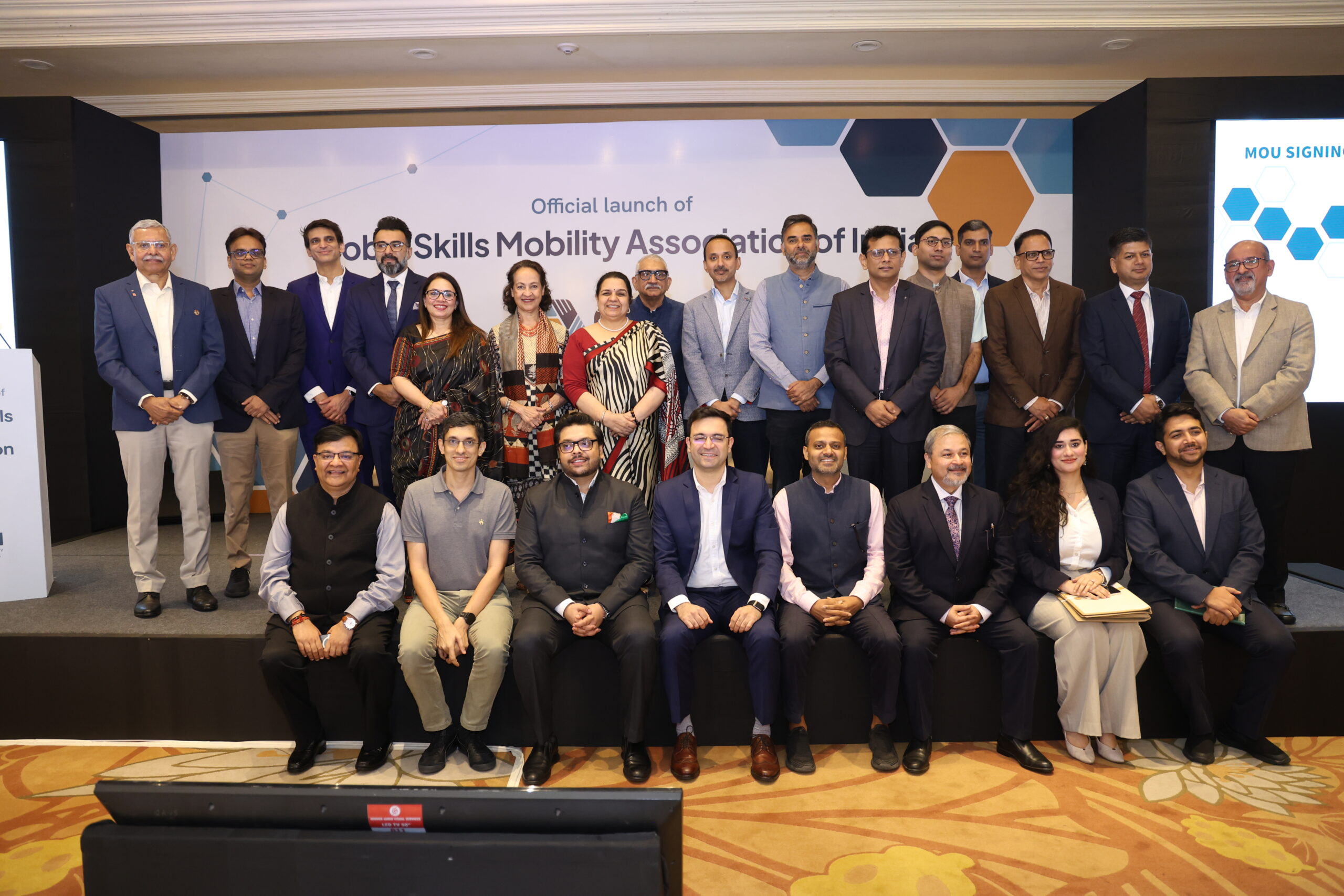
The Global Skills Mobility Association of India (GSMAI) was formally launched today at ITC Maurya, New Delhi, bringing together 17 founding organisations, government representatives, diplomatic missions, state governments and industry leaders to strengthen India’s role in global workforce mobility.
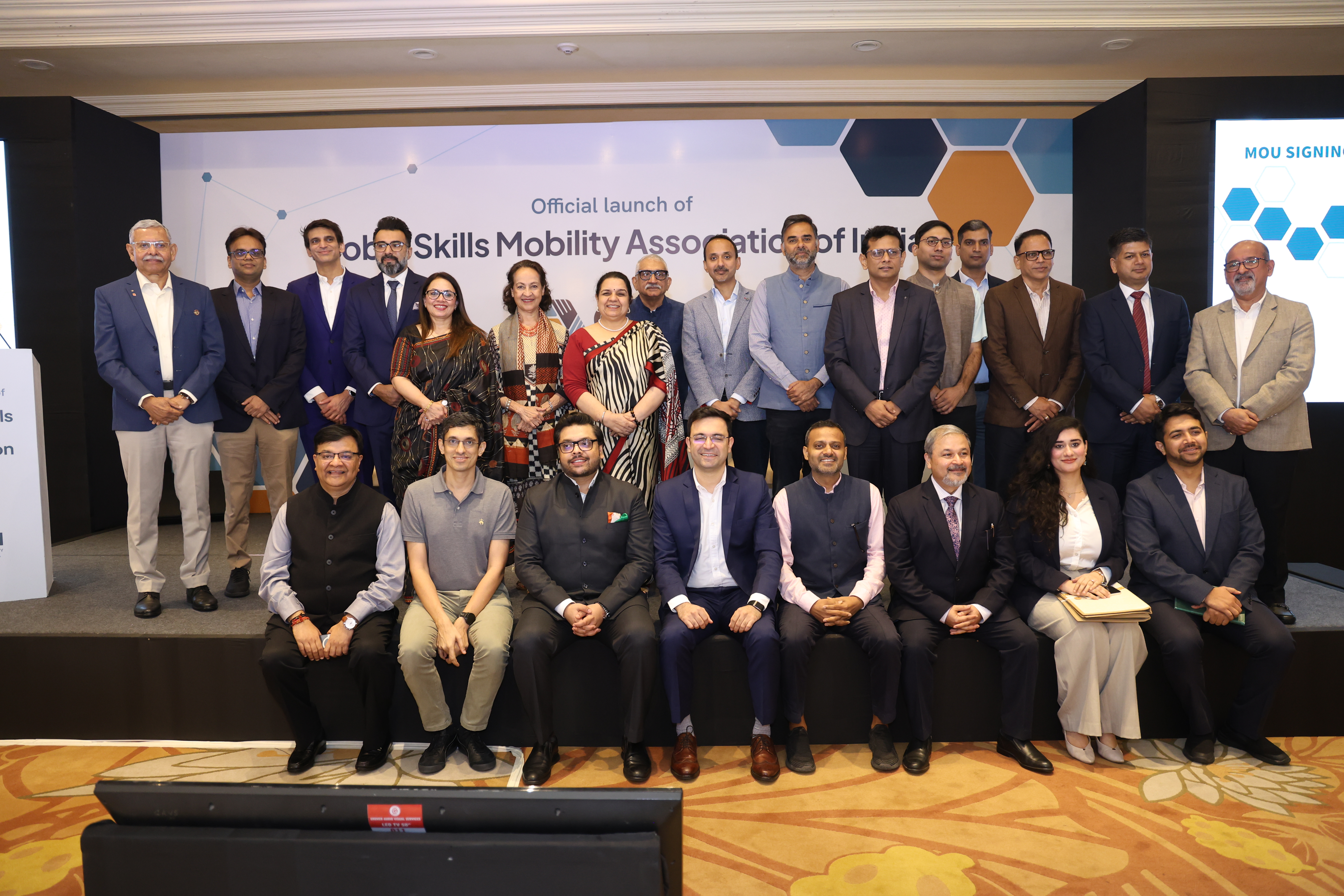 |
Founding members and industry leaders at the launch of the Global Skills Mobility Association of India (GSMAI) in New Delhi on 12 October 2026
Established as a not-for-profit Section 8 company limited by guarantee, GSMAI aims to build trust and coordination across the systems connecting Indian talent with global employment opportunities.
Recruitment, skilling, language training and employer engagement have long operated in separate lanes. GSMAI brings together 17 organisations across these areas: Ambe International, Magic Billion, VFS Global, Learnet Skills, Dynamic Staffing Services, 2COMS, Quess Corp, BorderPlus, Virohan, TeamLease Services, TERN Group, Adecco, Randstad India, UDS, CENTA, LeverageEdu and AnywhereJobs. The association seeks to strengthen coordination across the global skills mobility value chain, building trusted pathways from training to international employment.
The launch comes as working-age populations in Japan, Germany and Italy shrink and demand for international talent grows. India is well placed to respond: for every person aged 50 or above, India has approximately 1.4 people under 18, about five times Japan’s ratio and roughly four times Germany’s. Realising this demographic advantage requires ethical recruitment, language readiness, recognised qualifications, worker protection and stronger international partnerships.
Shri Vikram Misri, IFS, Foreign Secretary, Ministry of External Affairs, Government of India, delivered the inaugural keynote and unveiled the GSMAI logo and website alongside the founding board.
Addressing the future of India’s global skills mobility, Shri Vikram Misri said, “India’s skill mobility must not be treated as a one-way exit. We want our people to go abroad, experience, earn well, build networks and acquire technologies and return, or contribute to India from afar.”
The programme also featured a keynote by Shri Shashank Mani, Hon’ble Member of Parliament, Lok Sabha, and Chairperson of the Standing Committee on Labour, Textiles and Skill Development, Parliament of India, who highlighted “There is almost a need for 65 to 70 million people globally, and India has a surplus of professionals of the 40 million variety. This mismatch has to be answered by institutions which are bringing them together.”underscoring the opportunity to connect India’s talent and skilling capabilities with evolving global workforce needs.
Ajay Khanna, Founding Chair, GSMAI, emphasised collective industry action to translate global demand into trusted pathways for international employment. He said, “We can treat global skills mobility as a series of transactions, or approach it as a national responsibility. We can remain suppliers, or become partners. GSMAI gives us the opportunity to choose credibility over convenience and institution-building over improvisation.”
Mayank Kumar, CEO border plus ”I think most states are coming to terms that it’s not a volume game, it’s a quality game.”
Neeti Sharma, CEO Teamlease “Skill is the currency that we need. The most important thing is ethical circular mobility and for you to have ethical circular mobility with the skills and with the kind of demand that is there in the world, it has to be digitally credentialised.”
GSMAI’s opportunity extends beyond connecting workers with overseas jobs. It lies in strengthening the systems linking workers seeking rewarding careers, employers seeking the right skills and countries addressing workforce needs. Better coordination across recruitment, training, qualification recognition and international partnerships can make mobility more transparent, responsible and mutually beneficial.
The launch also featured a diplomatic and industry dialogue on trusted talent corridors. Embassy representatives from Germany, Italy, Denmark and Switzerland joined industry leaders to discuss workforce demand, employer expectations, qualification recognition, language training, ethical recruitment and pathways connecting local skilling with overseas employment.
The state-level dimension was reflected in partnerships with the Governments of Maharashtra and Odisha, represented by Smt. Manisha Verma, IAS, Additional Chief Secretary, SEEID, Government of Maharashtra, and Shri Bhupendra Singh Poonia, IAS, Commissioner-cum-Secretary, Government of Odisha, respectively. These collaborations aim to connect state-level talent and skilling initiatives with international employment opportunities.
Going forward, GSMAI will focus on ethical recruitment, market intelligence, amplifying the industry’s collective voice and connecting recruiters, employers, training providers, governments and international partners. These priorities aim to strengthen trust and align skills development with international workforce requirements.
GSMAI’s long-term ambition is to position India not merely as a source of global talent, but as a trusted partner in meeting the world’s evolving workforce needs—creating opportunity for Indian workers, confidence for global employers and lasting value for countries on both sides of the mobility corridor.
Drawing a parallel with India’s IT story, Arnab Bhattacharya, CEO, GATI Foundation, said, “In 1988, India’s IT industry gave itself a name and a voice. It grew into a $315 billion industry employing 5.95 million people. Global skills mobility is at that same moment today. India has the young workforce and the world has the demand. What has been missing is an industry that can speak with one voice.“
The launch marks the beginning of a collective effort to make global skills mobility more trusted, transparent and accessible, turning India’s talent advantage into a lasting global opportunity.
About GSMAI
The Global Skills Mobility Association of India (GSMAI) is a not-for-profit Section 8 company limited by guarantee established to strengthen India’s global skills mobility ecosystem. It brings together organisations across recruitment, skilling, language training and workforce mobility to bridge the gaps between talent, skills and global workforce demand through industry collaboration and trusted international partnerships.

